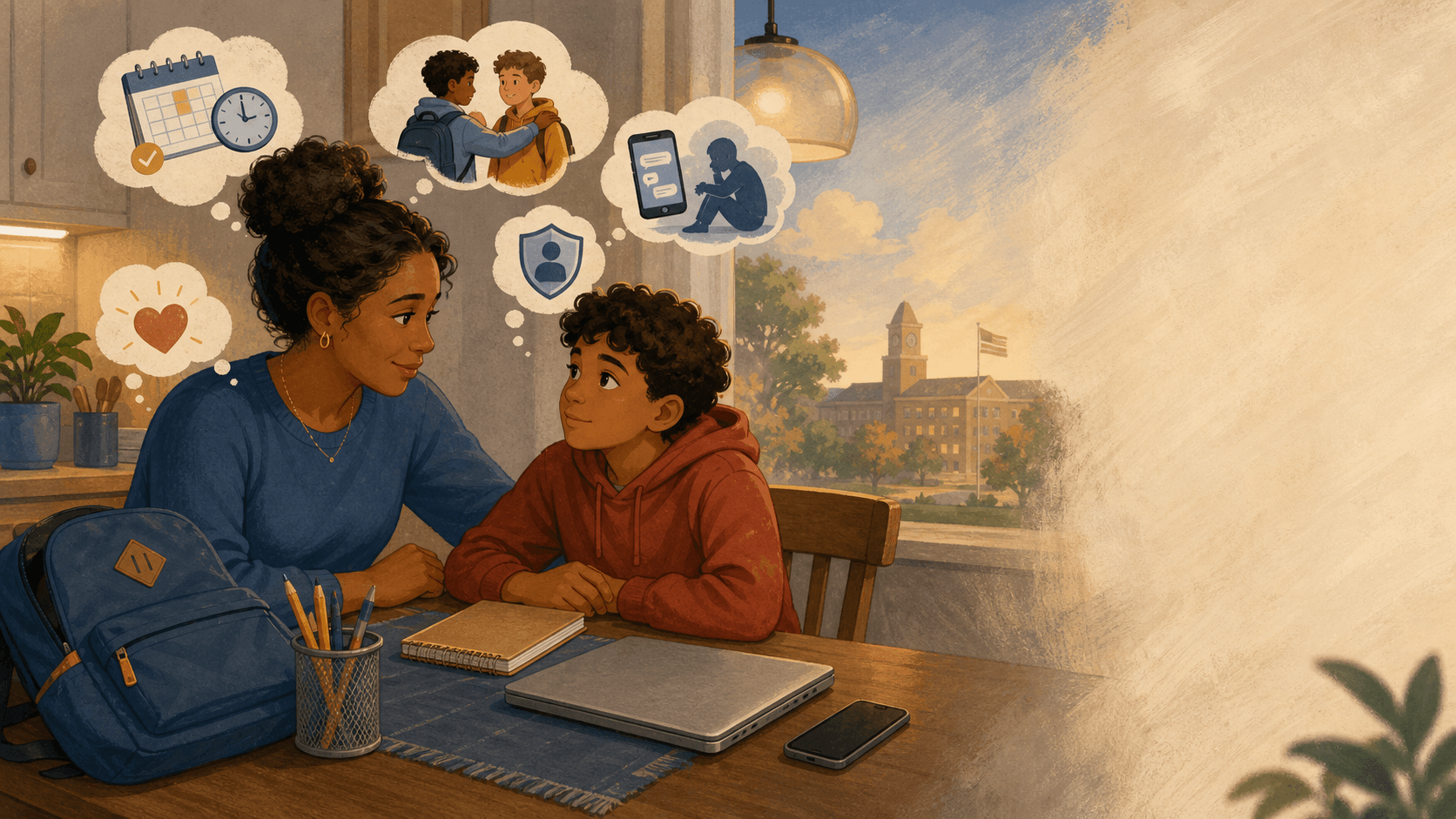
Plano ISD starts Tuesday, Aug. 11, 2026, and many families are close enough to the first day that preparation has started to feel real. In Plano, that often means a return to tight schedules, strong academic expectations and evenings that can fill up faster than anyone planned.
That can make parents feel like they need a perfect system before school begins. They do not. What helps most is clarity: clear routines, clear expectations and clear conversations about the issues children are likely to face once the year gets underway.
That includes more than homework. It includes what happens when friendships turn mean, when online life follows children into school, and when AI becomes one more temptation to take the easy way around difficult work.
Simplify the home routine enough to keep it real
Many Plano families do not need more ambition in August. They need fewer points of friction.
That might mean charging phones outside bedrooms. It might mean a homework start time that does not drift into the end of the night. It might mean backpacks, laptops and shoes having one dependable place so mornings are not built around searching for lost items.
The right routine is not the fanciest one. It is the one the family can actually keep once the week gets crowded.
Stanford's Denise Pope has spent years talking about student stress and the difference between productive structure and pressure for pressure's sake. That distinction matters in Plano homes. If a routine helps a student feel more prepared and less frantic, it is worth keeping. If it mostly raises the temperature in the house, it probably needs simplifying.
One honest question for parents is this: where does the school week start to unravel first? That answer is usually more useful than any generic list of back-to-school tips.
Give children language for bullying before they need it
Children often know when a situation feels uncomfortable. They may not know whether it is serious enough to tell an adult, or they may assume adults will not understand the social pressure involved.
This is where parents can help before the moment arrives. What does repeated exclusion look like? What happens when a child becomes the running joke in a class or friend group? What if your child sees the problem clearly but worries that speaking up will cost them socially?
Sameer Hinduja's work at the Cyberbullying Research Center points back to one useful truth: children do better when home is both warm and structured. That means the child feels supported, but also knows the adults care enough to name bad behavior for what it is.
A plain family rule helps: if someone is being targeted over and over, or if something feels humiliating or unsafe, bring it home. We can decide together what comes next.
Assume cyberbullying will matter, even if you hope it does not
Online conflict is no longer a separate category. It is often the continuation of the school day by other means.
For Plano students, a message thread or screenshot can shape social life just as much as what happens in class. That is why parents do not need to wait for a crisis to talk about it.
Ask what group chats are usually like. Ask what happens when someone posts something embarrassing. Ask what kinds of comments get screenshotted and spread. Those questions tend to open better conversations than a broad warning about being careful online.
The American Academy of Pediatrics, in guidance by Dr. Megan Moreno, warns parents not to jump first to taking away devices when a child reports cyberbullying. The concern is straightforward: children who expect immediate punishment may stop reporting what is happening.